Turning Ideas into Impact
Every successful business starts with an idea. An idea alone is not a business. Between spotting a problem and running an enterprise sit some questions. Do customers actually want this? Can it be built affordably? Who will fund it? Who can guide the founder?
For students researchers and first‑time founders these questions can feel overwhelming. A startup incubator in India can make a difference.
India’s startup ecosystem has grown rapidly over the past decade. According to the Ministry of Commerce and Industry India had than 2.23 lakh government‑recognized startups as of 31 March 2026 and these had generated over 23.36 lakh direct jobs. Than 55,200 startups were recognised during FY 2025–26 alone.
Launching is the first step. Winning customers generating revenue and sustaining growth all require the guidance, resources and ecosystem. Startup incubation provides support to bridge that gap.
Key Takeaways
• A startup incubator in India helps early‑stage founders validate ideas build products and prepare for growth not just launch a company.
• The main benefits are idea validation, product development, mentor ship, funding guidance, market access and financial discipline.
• Funding scheme amounts are limits, not guaranteed grants for every startup.
• The best incubator is the one that fits your stage and needs not the best‑known name.
What Is a Startup Incubator?
A startup incubator in India is an organization or programme that supports early‑stage businesses as they develop and validate ideas build products and lay the foundation for growth. By tackling every challenge founders can tap into experienced mentors, industry networks, business guidance and funding opportunities.
Depending on the programme startup incubation may include:
• Business model development: identifying target customers defining the value proposition and evaluating revenue opportunities.
• Mentor ship: guidance from entrepreneurs, industry professionals and subject‑matter experts.
• Product development: building prototypes and minimum viable products (MVPs).
• Funding assistance: understanding grant opportunities, preparing applications and connecting with investors.
• Market access: building customer relationships and exploring pilot projects and industry partnerships.
• Business support: planning, legal compliance, intellectual property and operations.
The goal is not simply to help founders launch. The goal is to help founders make decisions test their assumptions and build a foundation for long‑term sustainability.
Six Ways a Startup Incubator Helps Turn Ideas into Businesses
1. Validating Ideas Before Investing Significant Resources
One of the challenges for entrepreneurs is knowing whether an idea solves a customer problem. A product may look innovative. Innovation alone does not create demand. Founders need to understand who their customers are what problems they face how they cope today and whether they would pay for a solution.
A startup incubator in India helps founders answer these questions systematically through customer discovery, market research, competitor analysis and business model evaluation.
Example: A student is building an app that connects farmers with restaurants. Before investing in technology the student needs to know whether farmers will use the platform whether restaurants will buy through it and how the business will earn revenue. Through a startup incubator in India the student can run interviews, test assumptions and surface problems before committing resources.
Why it matters: Early validation reduces mistakes and keeps founders focused on solutions backed by real customer needs than assumptions.
2. Turning Concepts into Market‑Ready Products
A idea must eventually become a product or service customers can use. This often starts with a prototype or minimum viable product (MVP): a version built to test features and gather user feedback.
A startup incubator, in India helps founders pick which features to priorities, how to test the product and what to improve before the product goes to market.
Example: A startup that builds a water‑quality monitor might begin with a prototype and test its accuracy in many locations. The feedback from those tests can help the team build a device that's more reliable, easier to use and cheaper to make before the company expands production.
Why it matters: Learning from real‑world evidence is cheaper than spending a lot of money on a product that has never been tested.
3. Accessing Mentor ship and Industry Expertise
Founders have to make decisions in areas where they have no experience. How should the product be priced? When should the first employee be hired? How can a startup win customers when money is scarce? What should a financial forecast contain?
These questions become easier when founders can learn from professionals. A structured mentor ship program can connect entrepreneurs with experts in marketing, finance, technology, operations, legal compliance and business strategy. Good mentors question assumptions, share ideas and point out risks that might otherwise be missed.
The valuable help comes from guidance that matches a startup’s industry, stage and challenges instead of generic advice.
Why it matters: For first‑time entrepreneurs, access to experience shortens the learning curve and improves the quality of business decisions.
4. Improving Access to Funding Opportunities
Startups those that build technology‑heavy products or enter markets that need a lot of money need funding. Still early‑stage businesses often have trouble attracting investors because they do not yet have revenue, traction or a proven business model.
An incubator can help founders understand their financing options prepare business plans create projections and sharpen investor presentations.
In India the Startup India Seed Fund Scheme (SISFS) was designed to support early‑stage startups through incubators. Its published framework provides for:
• Grants of up to ₹20 lakh for proof of concept, prototype development and product trials.
• Investments of up to ₹50 lakh through debt or convertible instruments for commercialization and scaling.
These amounts are limits of the scheme not guaranteed funding for any startup. Eligibility, application windows, incubator allocations and selection criteria should be checked before applying.
The incubator’s role goes beyond introducing founders to funding sources. It helps founders understand the capital they need prepare applications and connect funding needs to measurable business milestones.
5. Building Industry Connections and Accessing Markets
A strong product is not enough if potential customers never find it. For startups in business‑to‑business markets reaching customers, distribution channels and industry partners can be as difficult as building the product.
Incubators help by facilitating networking, industry interactions, demonstration events and potential corporate partnerships. These connections can help founders:
• Present their solutions to customers.
• Explore pilot projects with organizations.
• Meet investors and strategic partners.
• Understand industry requirements and emerging market trends.
• Identify distribution and collaboration opportunities.
Example: A startup that builds an energy‑efficiency solution for buildings may gain a lot from being introduced to facility managers or property developers who can test the product in an operating environment.
Why it matters: The value is not a network for its own sake. It is a set of opportunities to test, sell and improve the product.
6. Developing Financial Discipline and Sustainable Business Models
A startup can attract attention. Even make sales without becoming profitable or financially sustainable. Founders need to understand their costs, pricing, cash flow, customer acquisition expenses and working‑capital needs to make decisions.
Business incubation helps founders build models and track indicators:
• Customer acquisition cost (CAC) – measures how much it costs to acquire a customer.
• Gross margin – shows how much revenue remains after costs.
• Monthly cash burn – shows how quickly the startup spends its cash.
• Cash runway – estimates how available cash can support operations.
• Customer retention – helps assess whether customers keep using the product.
• Revenue growth – tracks changes in performance over time.
Example: A startup’s sales are rising quickly. Its customers pay invoices after 90 days. Without working capital the business may struggle to pay employees and suppliers even while reporting rising revenue.
Understanding cash flow and working‑capital management helps founders spot risks before they become operational problems. The ultimate goal of incubation is not just to help a startup launch but to equip founders to operate, adapt and grow.
How AIC‑BIMTECH Supports Entrepreneurs
Atal Incubation Centre – BIMTECH (AIC‑BIMTECH) is supported by Atal Innovation Mission and NITI Aayog. Is part of India’s startup incubation network. AIC‑BIMTECH gives entrepreneurs a route to get help as they develop their businesses.
Its published programme framework has four tracks, each designed for a stage of entrepreneurial progress:
Track | Stage | Focus |
KHOJ | Pre‑incubation | Helps people who want to start a business look at ideas, test business models and learn the first steps of building a venture. |
PRARAMBH | Incubation | Focuses on building products that move toward an MVP getting mentorship and getting ready for pilot launches and early customers. |
GURUKUL | Acceleration | Supports startups that already have traction as they focus on gaining customers making sales and expanding the business. |
UDAAN | Funding support | Focuses on routes to funding, investor networks and useful grant opportunities for startups. |
This shows a rule of incubation: founders need the help at the correct time. A founder with an idea needs help checking whether customers want it. A startup that already has a product may need help with sales, industry links and funding. Matching help to the venture’s stage lets founders focus on the problems that matter now.
What to Look for in a Startup Incubator in India
Choosing an incubator is a decision. Do not look at the name of the place. Ask whether the programme can solve the problems you face. There are seven things you should check:
• Help: Does the programme cover idea verification, prototype building, early sales or scaling?
• Mentorship quality: Does it give you access to people who have industry knowledge?
• Technical resources: Are there places to prototype, test or get help when you need it?
• Funding guidance: Does it explain how to find grants, seed money and what investors look for?
• Industry links: Can it arrange customer talks, pilot projects or useful partnerships?
• Transparent terms: Are fees, equity demands, programme length and selection rules clearly spelled out?
• Proof of progress: Can the incubator show real startup successes, partnerships or other measurable outcomes?
The right incubator is not necessarily the one with services. It is the one whose expertise, resources and network best match your startup’s needs.
Asked Questions
What is the difference between a startup incubator and an accelerator?
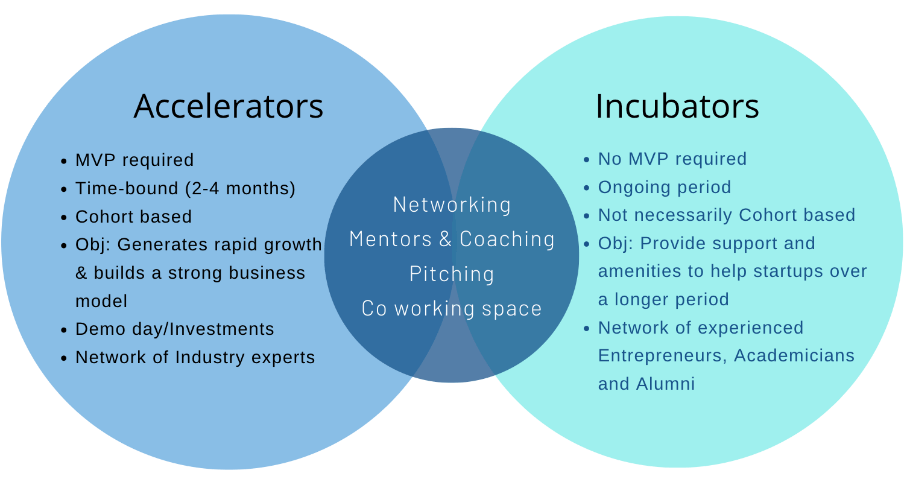
Incubators usually work with founders who are still early. They help them test ideas build a product and shape a business plan. Accelerators usually work with startups that already have some traction. They focus on customer growth, sales and expansion. Many places, including Atal Incubation Centre – BIMTECH (AIC‑BIMTECH) give help at both stages.
Do startup incubators guarantee funding?
No. An incubator can help you understand funding options prepare applications and meet investors. You get funding only if you meet eligibility, selection rules and have a business. Scheme amounts such as those under SISFS are limits, not promises.
Do incubators charge fees. Take equity?
Terms vary for each programme. Before you apply check if the incubator asks for fees takes equity and how long the programme lasts.
Can students and first‑time founders join an incubator?
Many programmes are made for this group. Pre-incubation tracks like Atal Incubation Centre – BIMTECH (AIC‑BIMTECH) KHOJ are for aspiring entrepreneurs who are still exploring and checking an idea. Check the eligibility rules on the programme page.
From Entrepreneurial Ideas to Sustainable Businesses
India’s growing startup scene offers chances in fields such as health care, farming, schools, money tech and climate work. Turning an idea into a lasting business needs more than cleverness and drive. Founders must check customer interest build products get the help manage money and build real market ties.
A startup incubator in India can bring all these pieces together. It helps entrepreneurs face uncertainty and creates a base for growth.
For founders the key question is not whether you have an idea. The key question is whether you are ready to test what you think learn from feedback and change your business to fit market needs. That is where the right incubation system makes all the difference.
Are you ready to take the step? Explore AIC‑BIMTECH’s incubation programmes to learn more about the support, for aspiring entrepreneurs and early‑stage entrepreneurs. AIC‑BIMTECH gives you the tools you need.