Accelerator vs. Incubator: Which is right for your Startup ?
Once you have an idea and possibly a basic prototype, you may be unsure of what step to take now. Should you continue building your product, look for mentors or seek funding?
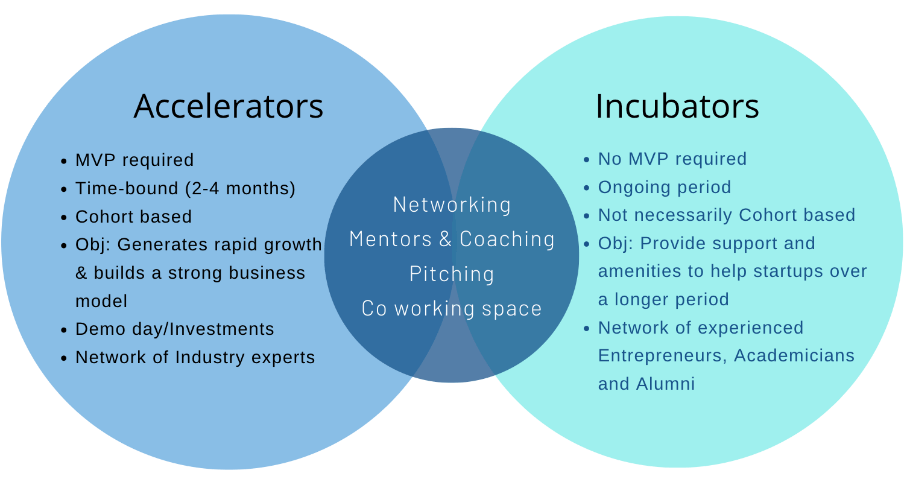
This is where Startups Incubators and Accelerators are used. Whilst they are both used to support founders they tend to be used at different stages of the startup journey. Incubators would support founders to build a foundation for their startup and turn their idea into a product. Accelerators would help to speed up the progress of a startup.
For entrepreneurs building a startup in India, you can identify an appropriate programme that can help you gain valuable mentors, help you connect within the industry and know what the next steps are. Make sure that you select the one that best fits your current business.
What is a Startup Incubator?
These programmes help you develop your idea and see if it can be turned into a proper product. They may offer mentorship, space, technical support and help identify your target customers and their needs.
For example, if you wanted to start a Health Tech Startup and have no prototype or have not talked to potential customers yet, an incubator can help you to identify the problem, connect with technical experts and what is required to get your idea to market.
Support provided can include:
Mentorship from experienced founders and industry experts;
Support with building a prototype, proof of concept or initial testing;
Access to labs, space, tools and technical;
Market research and support with testing your model;
Connecting with grants, investors and relevant government schemes.
Incubators in India can be run by Universities, Research centres, Government bodies or independent groups. For example, the Startup India Seed Fund Scheme has provided support to eligible startups through selected incubators. Funding can be provided to help with proof of concepts, prototypes, product testing and getting to market depending on the scheme and terms.
If your startup is in the early stages of testing your idea, building your initial product or figuring out how to make money then an incubator can be a great option.
What is a Startup Accelerator?
Accelerators help startups to develop in a short time frame. They typically offer structured mentorship, connections within the industry and practical advice.
Most accelerators will look for startups with something of a developed product, some indication of customer demand or initial paying customers. This means they can help improve sales, reach more customers, build partnerships and prepare for investment.
They can offer:
· Focused mentorship from founders and experts;
· Connections to investors, customers and potential partners;
· Advice on pricing, sales and customer acquisition;
· Support with increasing revenue and entering new markets;
· Pitching practice and investor connections;
· Connections within the industry and corporate partnerships.
Some accelerators invest in return for equity whilst others are funded through grants, sponsors etc.
Not all accelerators invest and some incubators work with startups that have customers. Make sure you check what the specific terms are for the programme you are looking at.
If your product is gaining traction and the main issue you face is growing your business then an accelerator may be the best option for you.
Key Differences
Factor | Incubator | Accelerator |
Main goal | Develop and validate the business | Help the business grow faster |
Typical stage | Idea, prototype, early validation | Validated product or early traction |
Duration | Often several months or longer; may be flexible | Often a few months on a set schedule |
Mentoring | Foundational, ongoing guidance | Intensive, goal-focused coaching |
Funding | May offer grants, seed support, or introductions | May invest or provide investor access |
Equity | Depends on the programme | Depends on the programme |
Working style | Development-focused and often flexible | Structured around goals and milestones |
Best fit | Founders still shaping a workable model | Founders ready to scale |
Whilst these are typical examples, make sure you check what the criteria, length, costs, funding and requirements of the programme are.
Which is right for you?
Identify what issue you need to solve.
If you are still figuring out what your customers want, building your first prototype or validating your model then an incubator would be best for you. If you have customers buying your product and have shown there is real demand then an accelerator can help improve sales, build partnerships and prepare for expansion.
It doesn’t matter what the most famous programme is, make sure you pick what will help your startup overcome the current issue.
Why Startups are important in India.
There are many types of startups in India including tech, healthcare, manufacturing, agriculture, education and consumer. However not all founders will have access to mentors, tools, connections and initial funding.
Incubators and government run programs can help address this.
According to government data there were over 2.23 lakh DPIIT recognised startups as of 31 March 2026, creating over 23.36 lakh direct jobs. Over 3,400 startups had been approved for funding by selected incubators under the Startup India Seed Fund Scheme by April 2026.
Whilst this gives an indication to how big the industry is, it doesn’t mean you will necessarily receive funding if you join a programme. Make sure you check the latest official data and treat all programmes as an opportunity.
Top 5 things to consider.
· Check what stage your product is at. If you are still researching the problem or building your first prototype then an incubator may be a better option. If your product is live and your customers want it then an accelerator may be better.
· Identify what your main issues are. Make a list of the top 3 things that are holding you back. Often if you are struggling with product development and validation then an incubator would be best. If you struggle with sales, customer acquisition and investor connections then an accelerator may be better.
· Consider what industry experience you need. If you are starting a Health Tech Startup you may need lab access, regulatory advice or clinical partners. If you are starting a consumer brand then you may benefit more from retail and distribution connections.
· Check the financial requirements. Make sure you know what fees, equity, investment, grants and other requirements there are. If you are giving away equity, make sure you know what this means.
· Ask about the programme’s history. If possible, talk to past participants and see if they gained any benefits such as gaining customers, improving their product, raising funds or finding useful partners. A smaller programme that is relevant can be more valuable.
Picking the most famous programme.
Not all programmes will be right for your industry and stage.
Applying when you are not ready. Make sure you are able to talk about your target customer, what problem you are solving and how the business may work.
Assuming you will get funded. Just because you get accepted doesn’t mean you will get investment.
Not considering giving up equity. Whilst you may lose some ownership it could be worth it if you are gaining value.
Assuming mentors will do all the work. Whilst mentors will help with advice and connections you still need to test your ideas, talk to customers and action them. Pick the programme that will help you make real progress.